How Untreated Hearing Loss Affects Your Balance
How Untreated Hearing Loss Affects Your Balance
How Untreated Hearing Loss Affects Your Balance
How Untreated Hearing Loss Affects Your Balance
Did you know that one of the leading causes of injuries—and sometimes even fatal injuries—in American adults is falling?
According to the Centers for Disease Control and Prevention (CDC), falls caused over 36,000 deaths in 2020 for adults ages 65 and older – and emergency departments recorded three million visits due to non-lethal falls.
Fall risk management is closely related to hearing loss challenges; the vestibular system plays a significant role in your balance, and thus, your risk of falling.
Recent research suggests that by improving your vestibular and auditory functions—as in getting your hearing tested and taken care of—can significantly improve your fall risk management.
This study, done by Joseph Sakamura, Au.D. and Richard Gans, PhD, looked into how improving your cognitive, vestibular, and auditory functions can reduce your fall risk – and their results were fascinating.
One quote that caught my attention from the study was this: “The cognitive overload of attending to a highly dynamic world for individuals with hearing loss, vestibular dysfunction, and cognitive decline increases the likelihood of a fall.”
Hearing loss affects far more than just your ears – your entire body suffers the aftershocks of your auditory function not working as well as it should.
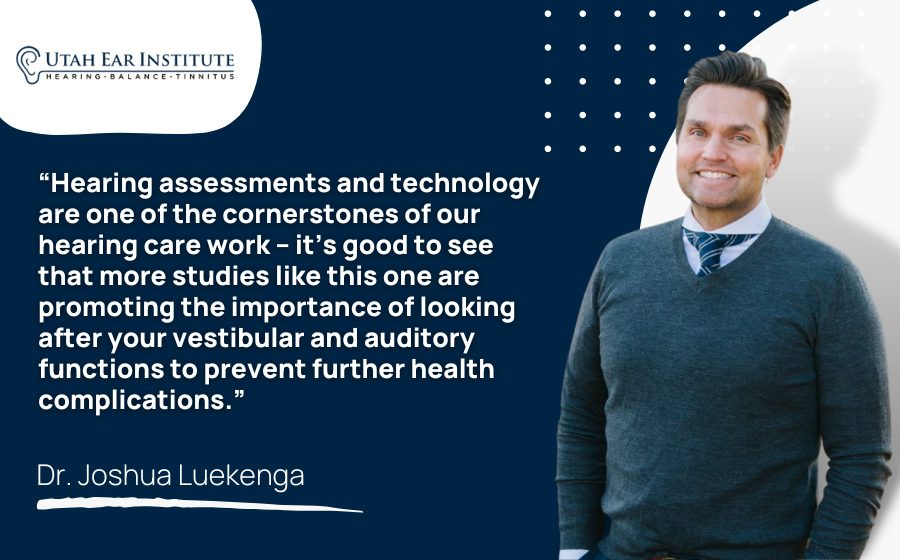
Hearing assessments and technology are one of the cornerstones of our hearing care work – it’s good to see that more studies like this one are promoting the importance of looking after your vestibular and auditory functions to prevent further health complications.
Falls are a significant health concern for adults, especially as we get older. However, by improving these functions, you can maintain your balance, reduce your risk of falling, and improve your hearing simultaneously.
How Hearing Care Can Help You with Utah Ear Institute
Personalized hearing care can help improve your risk of a fall by taking care of your auditory, vestibular, and cognitive functions – all with the help of a comprehensive hearing assessment.
A comprehensive hearing assessment will examine your hearing through various tests, which will help us understand your overall vestibular health and what level of hearing you’re working with before the introduction of assistive technology.
If you or a loved one has been struggling with a hearing loss challenge, please feel free to find the office closest to you and contact us to schedule an appointment.
You can also request a callback if you need more information; a member of our team will be glad to get in touch and help you with whatever questions you may have.
Request a Callback
Search
How Untreated Hearing Loss Affects Your Balance
Did you know that one of the leading causes of injuries—and sometimes even fatal injuries—in American adults is falling?
According to the Centers for Disease Control and Prevention (CDC), falls caused over 36,000 deaths in 2020 for adults ages 65 and older – and emergency departments recorded three million visits due to non-lethal falls.
Fall risk management is closely related to hearing loss challenges; the vestibular system plays a significant role in your balance, and thus, your risk of falling.
Recent research suggests that by improving your vestibular and auditory functions—as in getting your hearing tested and taken care of—can significantly improve your fall risk management.
This study, done by Joseph Sakamura, Au.D. and Richard Gans, PhD, looked into how improving your cognitive, vestibular, and auditory functions can reduce your fall risk – and their results were fascinating.
One quote that caught my attention from the study was this: “The cognitive overload of attending to a highly dynamic world for individuals with hearing loss, vestibular dysfunction, and cognitive decline increases the likelihood of a fall.”
Hearing loss affects far more than just your ears – your entire body suffers the aftershocks of your auditory function not working as well as it should.
Hearing assessments and technology are one of the cornerstones of our hearing care work – it’s good to see that more studies like this one are promoting the importance of looking after your vestibular and auditory functions to prevent further health complications.
Falls are a significant health concern for adults, especially as we get older. However, by improving these functions, you can maintain your balance, reduce your risk of falling, and improve your hearing simultaneously.
How Hearing Care Can Help You with Utah Ear Institute
Personalized hearing care can help improve your risk of a fall by taking care of your auditory, vestibular, and cognitive functions – all with the help of a comprehensive hearing assessment.
A comprehensive hearing assessment will examine your hearing through various tests, which will help us understand your overall vestibular health and what level of hearing you’re working with before the introduction of assistive technology.
If you or a loved one has been struggling with a hearing loss challenge, please feel free to find the office closest to you and contact us to schedule an appointment.
You can also request a callback if you need more information; a member of our team will be glad to get in touch and help you with whatever questions you may have.
Request a Callback
Search
How Untreated Hearing Loss Affects Your Balance
Did you know that one of the leading causes of injuries—and sometimes even fatal injuries—in American adults is falling?
According to the Centers for Disease Control and Prevention (CDC), falls caused over 36,000 deaths in 2020 for adults ages 65 and older – and emergency departments recorded three million visits due to non-lethal falls.
Fall risk management is closely related to hearing loss challenges; the vestibular system plays a significant role in your balance, and thus, your risk of falling.
Recent research suggests that by improving your vestibular and auditory functions—as in getting your hearing tested and taken care of—can significantly improve your fall risk management.
This study, done by Joseph Sakamura, Au.D. and Richard Gans, PhD, looked into how improving your cognitive, vestibular, and auditory functions can reduce your fall risk – and their results were fascinating.
One quote that caught my attention from the study was this: “The cognitive overload of attending to a highly dynamic world for individuals with hearing loss, vestibular dysfunction, and cognitive decline increases the likelihood of a fall.”
Hearing loss affects far more than just your ears – your entire body suffers the aftershocks of your auditory function not working as well as it should.
Hearing assessments and technology are one of the cornerstones of our hearing care work – it’s good to see that more studies like this one are promoting the importance of looking after your vestibular and auditory functions to prevent further health complications.
Falls are a significant health concern for adults, especially as we get older. However, by improving these functions, you can maintain your balance, reduce your risk of falling, and improve your hearing simultaneously.
How Hearing Care Can Help You with Utah Ear Institute
Personalized hearing care can help improve your risk of a fall by taking care of your auditory, vestibular, and cognitive functions – all with the help of a comprehensive hearing assessment.
A comprehensive hearing assessment will examine your hearing through various tests, which will help us understand your overall vestibular health and what level of hearing you’re working with before the introduction of assistive technology.
If you or a loved one has been struggling with a hearing loss challenge, please feel free to find the office closest to you and contact us to schedule an appointment.
You can also request a callback if you need more information; a member of our team will be glad to get in touch and help you with whatever questions you may have.
Request a Callback
Search
Ask Dr. Josh
Our latest hearing health articles, resources & blogs
Cherrill's Story: Taking Action On Your Hearing in Utah
Hearing loss is often gradual. Learn from one of our patient's stories and see why taking action on your hearing health is a critical step.

What the Latest WHO Guidance Means for Your Hearing
Learn how new WHO guidelines link hearing health to dementia risk. Utah Ear Institute explains how to protect your cognitive health.

Robyn’s Hearing Health Journey: Rediscovering Hearing After Illness
Hearing changes don’t always give you a fair warning.
Ask Dr. Josh
Our latest hearing health articles, resources & blogs
Cherrill's Story: Taking Action On Your Hearing in Utah
Hearing loss is often gradual. Learn from one of our patient's stories and see why taking action on your hearing health is a critical step.
What the Latest WHO Guidance Means for Your Hearing
Learn how new WHO guidelines link hearing health to dementia risk. Utah Ear Institute explains how to protect your cognitive health.
Robyn’s Hearing Health Journey: Rediscovering Hearing After Illness
Hearing changes don’t always give you a fair warning.
Ask Dr. Josh
Our latest hearing health articles, resources & blogs
Cherrill's Story: Taking Action On Your Hearing in Utah
Hearing loss is often gradual. Learn from one of our patient's stories and see why taking action on your hearing health is a critical step.
What the Latest WHO Guidance Means for Your Hearing
Learn how new WHO guidelines link hearing health to dementia risk. Utah Ear Institute explains how to protect your cognitive health.
Robyn’s Hearing Health Journey: Rediscovering Hearing After Illness
Hearing changes don’t always give you a fair warning.